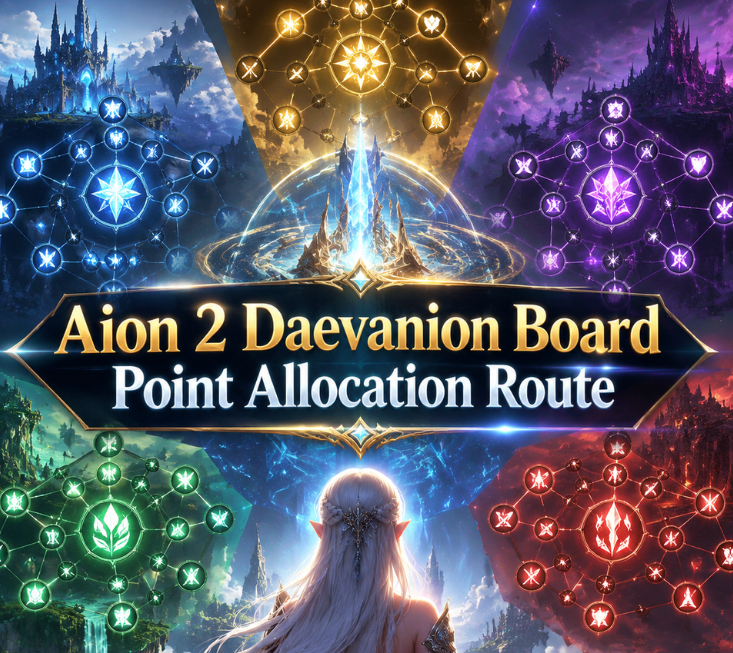
The Daevanion Board is one of the most important long-term progression systems in Aion 2. It gives players additional stats and skill levels through a connected network of nodes, allowing a character to become stronger even after basic leveling and equipment progression start to slow down.
The important part is that you cannot simply unlock every useful node at once. Points are limited, and reaching a valuable node often requires spending points on several connected nodes first. For that reason, planning your route around your actual build is much more effective than filling the board randomly.
How the Daevanion Board Works
The Daevanion system becomes available during character progression, with the first board opening at level 12. The current global setup contains five boards: Nezekan, Zikel, Vaizel, Triniel, and Azphel.
The first four boards use Daevanion Crystals, while Azphel uses its own PvP-oriented currency.
Each board starts from a central node. From there, players unlock connected nodes one by one. Different nodes provide different types of bonuses, including basic attributes, passive skill levels, active skill levels, and stronger special stats.
This means the actual cost of a powerful node is not just the cost shown on that node. You also need to consider every node required to reach it.
The Best Early Route
For most characters, the first priority should be the skills that form the core of the build.
Do not automatically choose a node because it is nearby. Look at your normal combat rotation and identify the abilities you use repeatedly. If a Daevanion node increases one of those important skills, it can provide more practical value than a small general stat increase.
A simple early priority is:
Core active skills
Important passive skills
Strong offensive or defensive stat nodes
Special nodes
Less important filler stats
This approach is especially useful while your character is still developing. Spending Aion 2 Kinah on equipment and other progression also becomes more effective when your Daevanion choices are already supporting the same build.
Nezekan: Build Your Foundation
Nezekan is the first board available and therefore becomes the starting point for most characters.
Its major special stats include Combat Speed and Cooldown Reduction. These are useful because they can improve the overall rhythm of a character’s rotation rather than increasing the damage of only one ability.
When planning your first route, look for core skill nodes that can be reached efficiently. If a path toward an important skill also leads toward Combat Speed or Cooldown Reduction, that route can be particularly efficient.
There is no reason to spend every available point immediately. Saving some crystals for a better route can be more valuable than taking several nodes that have little connection to your build.
Zikel: Increase Overall Combat Power
Zikel becomes available at level 20 and focuses on Damage Boost and Damage Tolerance among its major stats.
For offensive builds, Damage Boost is an obvious target. However, defensive options should not be ignored completely, especially for classes that spend a lot of time in melee range.
Assassin, Gladiator, Ranger, Sorcerer, and Spiritmaster builds can all benefit from offensive progression, but their preferred skill nodes will be different. A route should therefore be selected based on the actual skills being used rather than following another class’s board exactly.
Vaizel and Triniel: Specialize Your Build
Vaizel opens at level 30 and adds Critical Damage Boost and Critical Damage Tolerance to the board’s major options.
For damage-focused characters, Critical Damage Boost becomes increasingly attractive once the character already has a solid foundation of basic stats and skill upgrades.
Triniel opens at level 40 and introduces Multi-Hit Chance and Multi-Hit Resist as its major special stats. Because Triniel is a later progression board, it is a good place to further specialize rather than rebuilding the entire character around a completely different setup.
Class-Based Priorities
Different classes should not follow exactly the same route.
Assassin can prioritize the active skills used for burst damage before moving toward offensive special stats.
Ranger benefits from improving its main ranged damage abilities and then strengthening offensive stats that support sustained attacks.
Sorcerer should focus on the skills that form its primary magic damage rotation, especially abilities that are frequently used during PvE encounters.
Templar can place greater value on defensive progression and skills that support its role as a frontline tank.
Cleric should prioritize important healing abilities and supporting skills before investing heavily into general damage options.
The key principle is simple: the best Daevanion route is the one that strengthens what your character already does well.
A Practical Progression Plan
Instead of trying to complete one board immediately, consider using this general progression:
- Level 12–19: Build the core route on Nezekan.
- Level 20–29: Open Zikel and continue taking important skill and stat nodes.
- Level 30–39: Use Vaizel to strengthen your main offensive or defensive specialization.
- Level 40+: Begin investing into Triniel while completing the most valuable remaining routes on the earlier boards.
- Level 45+: If PvP is your focus, start planning around Azphel and its PvP-specific progression.
This method keeps your character’s power growth consistent without wasting a large portion of your crystals on low-value nodes.
Avoid These Common Mistakes
The biggest mistake is spreading points across too many unrelated paths. A board may contain many attractive nodes, but taking everything a little at a time can leave you without enough points to reach the bonuses that actually matter.
Another common mistake is copying a route designed for another class. The board layout may look similar, but skill nodes are tied to the character’s abilities, so the best route for an Assassin will not necessarily be ideal for a Cleric or Templar.
Equipment progression should also work alongside your Daevanion choices. If you decide to buy Aion 2 Items, make sure the equipment supports the same build instead of investing in stats that your Daevanion route does not prioritize.
Ultimately, there is no single perfect route for every Aion 2 character. Start with your core skills, build toward valuable special stats, and adjust the route as your class and playstyle develop. A focused Daevanion Board will usually provide much more value than simply unlocking nodes because they happen to be available.
